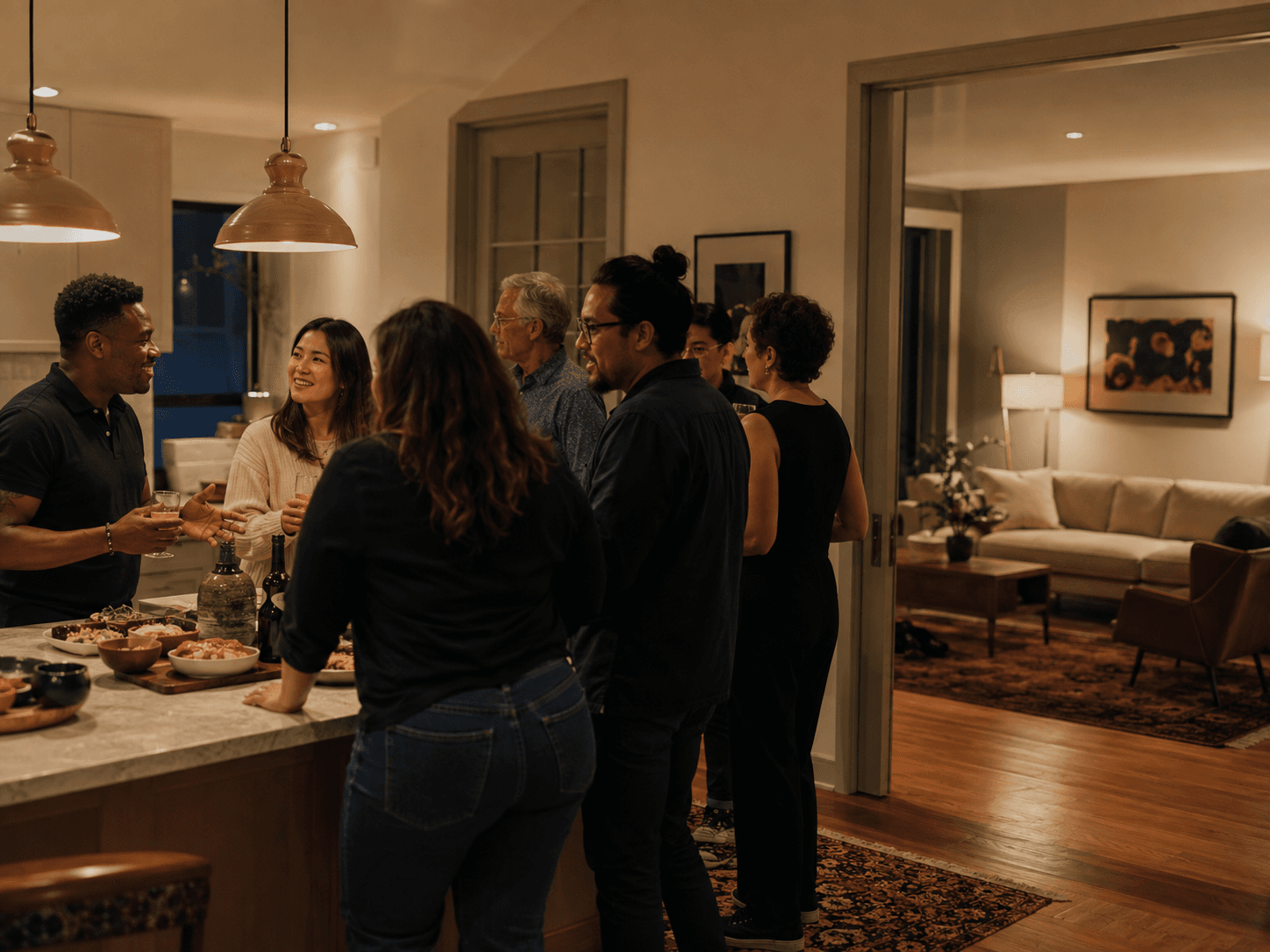
Every host has done this. You arrange the living room properly. Cushions straightened, chairs angled, a surface cleared for glasses. Then eleven people arrive and stand shoulder to shoulder in a kitchen the size of a lift, holding drinks, while the living room sits empty and beautifully lit.
It is not a failure of hosting. It is where the drinks are.
People stand where they can put something down
That is nearly the whole rule. A guest holding a glass and a small plate has no hands left, so they will drift until they find a surface at elbow height, and then they will stay there. If the only such surface is your kitchen counter, everyone will be at your kitchen counter, standing between you and the oven.
So the question is not "how do I get people out of the kitchen". It is "where else can someone put a glass down".
Three moves that do most of the work
Move the drinks away from the food. Not to another floor — just to the far end of whatever space you have. A side table, a sideboard, the end of a bookshelf. Drinks are the anchor; wherever they are is where the room forms. If drinks and food occupy the same square metre, so will your guests.
Give the kitchen one deliberate leaning surface. Trying to keep people out of the kitchen never works, so pick where in it you want them and clear that spot properly. The end of the island furthest from the hob. A stretch of counter with nothing on it. If you leave it ambiguous, people will choose the spot directly in front of the drawer with the serving spoons in it.
Check what is behind people. The bin, the fridge, the cupboard with the glasses, the door to the loo. Every one of those is a place someone will need to get to roughly forty times, and if the natural standing spot blocks one of them you will spend the evening saying "sorry, just squeezing past".
The bit nobody plans
Coats and bags. They go somewhere, and if you have not decided where, that place will be the chair you needed. A bed in a room with the light on is fine. A hook by the door is better. Deciding in advance takes four seconds and saves the small indignity of moving a stranger's coat off a dining chair while they watch.
A note on seating
For anything under about eight people, you do not need a chair each in the standing part of the evening — you need somewhere for roughly half of them to sit and a clear route between the two ends of the room. A room that is 60% full feels lively. A room that is 90% full feels like a queue.
If you are sitting down to eat, that is a different problem and a counted one: chairs, place settings, elbow room. But the hour before that is not a seating problem. It is a surfaces-and-drinks problem, and it is the hour that sets how the whole evening feels.